Shells
A short story

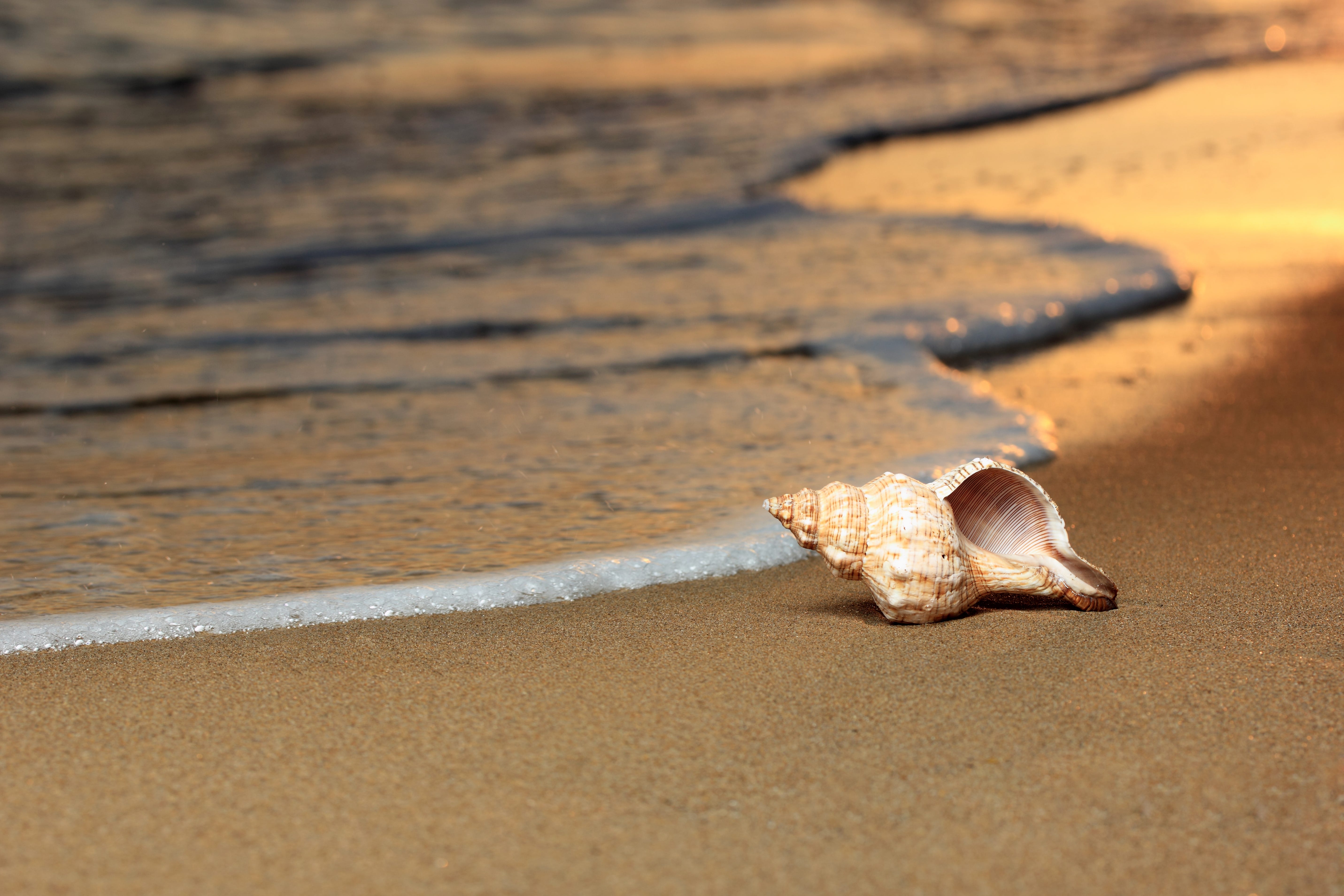
Author’s note: The fear of losing a child is familiar to every parent. Surely the fear is evolutionary: the stronger the love, the greater the fear, and the harder we work to protect our offspring. But of course there are some things we can’t protect them from. ‘Shells’ features a father who is desparately searching the beach for his daughter’s favorite shell. The father, who is not given a name (a device intended to make the story more universal), has just come from his daughter’s hospital bed. He is himself emotionally at sea, and with the help of one of those vaguely magical characters who appear sometimes in fiction, he finds something more important than what he went looking for. And in case the reader is wondering, I suffered the anxiety but, thankfully, never the loss.
Shells
He has been coming to this beach every week for months, and each time something surprises him. Sometimes it is the size of the waves, or the way they menace the shore, or the way they caress it. Today it is the water’s unhealthy pallor, as if there were no life left in the ocean.
He begins to look down, to do his errand. There aren’t many shells today, or many good ones. He knows it has to do with the tides, that there is well-understood science behind it, and one of these days he’ll learn it. Then he sees a colorful shell he can’t identify—a shell that will fit perfectly in a small hand—and he puts it in his pocket. There are plenty of big gray clams that aren’t worth picking up, and he knows they would feel lifeless and heavy if he did.
Elf would love it if he can find a conch. She even asked for one that morning, in the hospital: The swirly ones with the point. The idea must have been so powerful in her young imagination that a lack of words would not silence her. But a conch is too much to hope for. He’s seen one here (or it might have been a mile up the coast, or down it) back in the summer. She was with them then—not with him as he walked, thinking only of his own business, but back on the blanket with her mother. He wished now he’d picked it up, but at the time he had his cell phone in his hand. For some reason it seemed wrong to hold both the device and a seashell, as if one would contaminate the other. But he wasn’t the scavenger then, Elf was. She collected shells in a pink bucket and spread them on the blanket and her mother said, “That’s wonderful, honey!” without looking up from her book.
Remembering this causes a small spasm a few inches below his collar. These almost medical events have been occurring at unexpected moments, alone in the car or out here. Also at inconvenient moments, at work, even in meetings. But only when he is away from Elf, not with her. Thankfully not then.
Then he sees her, or rather feels her presence, standing further back from the water’s edge: a tall woman wearing a parka the color of a crayon that a child would choose to draw the sun. Her hair is white, or very pale yellow. The hair of someone who was once blonde. Her skin is a web of fine wrinkles, like a toy fishing net. She has the bright eyes of a much younger woman. She speaks to him.
“They’re more plentiful up there.”
“Really? I thought it was the time of day.”
“This isn’t the best spot any time of day. The currents up by the cove seem to bring them in. Isn’t it beautiful, though? The way the shore curves, and those rocks, how the waves break on the tip of them. Don’t you agree?”
He sees the things she describes but not the beauty, so he says nothing.
“You seem to be looking for something in particular,” she says.
“No—not exactly. Just anything unusual or pretty. They’re not for me.”
“I see.”
The sun is hanging, pale and delicate, just above the dunes. Has it just come out? Or has it been there all along and only now is he aware of it? The woman turns her face towards the sun, the motion seemingly involuntary, like a plant’s. The skin that in shadow was a fine mesh looks smooth. Or has been made smooth by her smile.
“Watch out!” she says, but happily, laughing almost, as though there is no danger.
And there is none. Only the water beginning to lap at the soles of his loafers.
“I suppose I shouldn’t be out here dressed like this.” He tries to say it laughing as well, but can’t catch her spirit. In his own voice he hears a bleakness that he hopes she does not.
“You must be coming from work. A salesman or—no, let me guess. A young executive.”
“Wrong and right. An engineer. But I manage a large group.”
He is eager to mention this, and looks for evidence that she is impressed. Instead she says:
“Are you a religious person?”
“I’m—”
It seems an impertinence, and besides he can’t say because he doesn’t know. A year ago, six months ago even, he knew. It was a rational world, an engineer’s world. This seems a very long time ago.
“I only ask because—well, because I wasn’t. But people change, or are changed. Now when I’m out here I get overwhelmed by . . . But I see that it doesn’t affect you that way. You have to admit it’s magnificent, though. Whether you believe it was designed or not.”
It seemed an uncontroversial point, the beauty, but still he can’t acknowledge it.
“The shells,” she says. “For a child?”
“Yes. For my daughter. She’s almost four. She’s—”
He stops himself Already he has said more than he intended. He knows this woman—not personally, but he knows her type. Not quite sure where the boundaries are, the insistent cheerfulness a result not of a mind that is whole but of one that is slipping. He is ready to get on with his day, with his duties.
“It’s a wonderful age,” she says. The only words she’s spoken without a smile. Which causes the face to relax and become old again.
He walks on, realizing only after several minutes that he is walking away from the car and towards the cove. The pickings are so slim today that he is ready to test her theory. If she’s correct he can thank her next time. The obvious question—whether there will be a next time—he refuses to consider.
The cove turns out to be further than it appeared. With the daylight going there will soon be no point to it. He walks quickly, feeling cold and exposed in his suit jacket. He expected the search to be closer to where he parked, and briefer. He thinks again of the tides, of the moon’s gravity and the equations that must describe the cycles. He can find the information easily enough, but decides against it. The ocean isn’t going to reveal itself that way, and he doesn’t want it to be revealed in any event. The rocky promontory, the southern barrier of the cove, looms dark and close. He begins to run.
When he reaches the cove the ground is covered with the things, not conches but scallops and sand dollars and iridescent oysters. He picks up a few of the larger shells, trying in the dying light to determine which might have the colors she enjoys. Then he sees her, is startled by the brightness of the yellow parka.
“You were right,” he says. “They’re all over the place.”
“Yes. But we have to work quickly. She’s four, you said?”
He does not question the implication that they will work together, or how an old woman made her way along the beach so quickly.
“Almost four.”
“A wonderful age. Here, I’m sure she’ll like this.”
It is a perfect specimen, not a conch but big and opalescent. He can make out streaks of pink and gold. How is it that she found in a moment what had been eluding him? How is it that at twice his age she appears to have twice his vitality? There is an animation, a buoyancy, in her gestures and in the smallest things she says.
“She’ll love it,” he says, feeling the soft ridges, the weightlessness. That he took it from her—that he didn’t refuse her help—makes no sense and yet feels both right and inevitable.
“What’s your little girl’s name?”
“Eleanor. But we call her Elf. She’s always been tiny.”
As soon as he says this the spasm comes, but a small one, not too difficult to control.
“And how long has she been ill?” says the woman.
“Not long. It all happened fast. One day she’s running around and the next my wife is calling me at work. It was just before Christmas, and—oh, I’m so sorry . . .”
“Nonsense,” she says. “What you’re feeling is perfectly natural.”
It is more difficult to control than he thought. But for some reason he is not ashamed. When he recovers himself he asks, “Did I—did I mention that my daughter is sick?”
He notices the youthful eyes are the color a child might imagine, or wish, the sea to be. At first she doesn’t answer. Then, bending spryly to pick up two irregular shells, she says:
“When I was younger, younger than you, I lost my son. And I do believe it marks a person. We know something that not everyone knows. We know each other.”
“But how can you be so—so content? It seems impossible, illogical even.”
“Yes, I suppose it is.” Her smile broadens and the fine wrinkles disappear. “Do you know what this is, or was?”
“An oyster.”
She puts the two halves together, as if the creature were again living, and says, “What you’ve lost—what you’re losing—will become a hard, sharp stone. It will always be there. And then time goes by. The edges soften and it becomes something interior, sealed off. Protected almost, the way precious objects should be.”
“I don’t quite understand.”
“I didn’t either. I still don’t, but I no longer expect to.”
Then she does exactly what he needs at the very moment he needs it: she leaves.
Alone, he looks out the open side of the cove to the distant line where the water is indistinguishable from the sky. He sees the beauty in it, and feels it. Then he notices something sticking partway out of the shallow pool. He takes a careful step where the water is shallow, to get a closer look. To make sure. The water is just above the sole of his polished shoes. The shell—he is sure now—is just a few steps away, no more than the length of the room where Elf’s bed is now always neatly made up. The bottom of the cove drops off, or perhaps the tide is coming in, and he feels the beginning of wetness inside his shoes. Just then the sun lights it up, the spiral edges metallic like the threads of a giant screw. A terrible and wonderful spasm deep inside makes him cry out a little, and he hurries through the ankle deep water and picks up the shell before the water carries it away.
The author would like to thank the Editors of The Write Place at the Write Time for permission to reprint this work.
I like how many of your sentences end with an intriguing twist. The exquisite attention to detail provides additional insights into your main character. Indeed, your capacity to describe lucidly this poor soul's shifting levels of abstraction (perception, emotion, thoughts, and interactions) reminds me of Joyce.
Everything fits. No distractions from leaving anything out, none from overwriting.
The words slide into place one after the other.
No surprise considering Shapiro's art and craft.